Custom Radioastronomy Software
Adventures into SDR-RTL
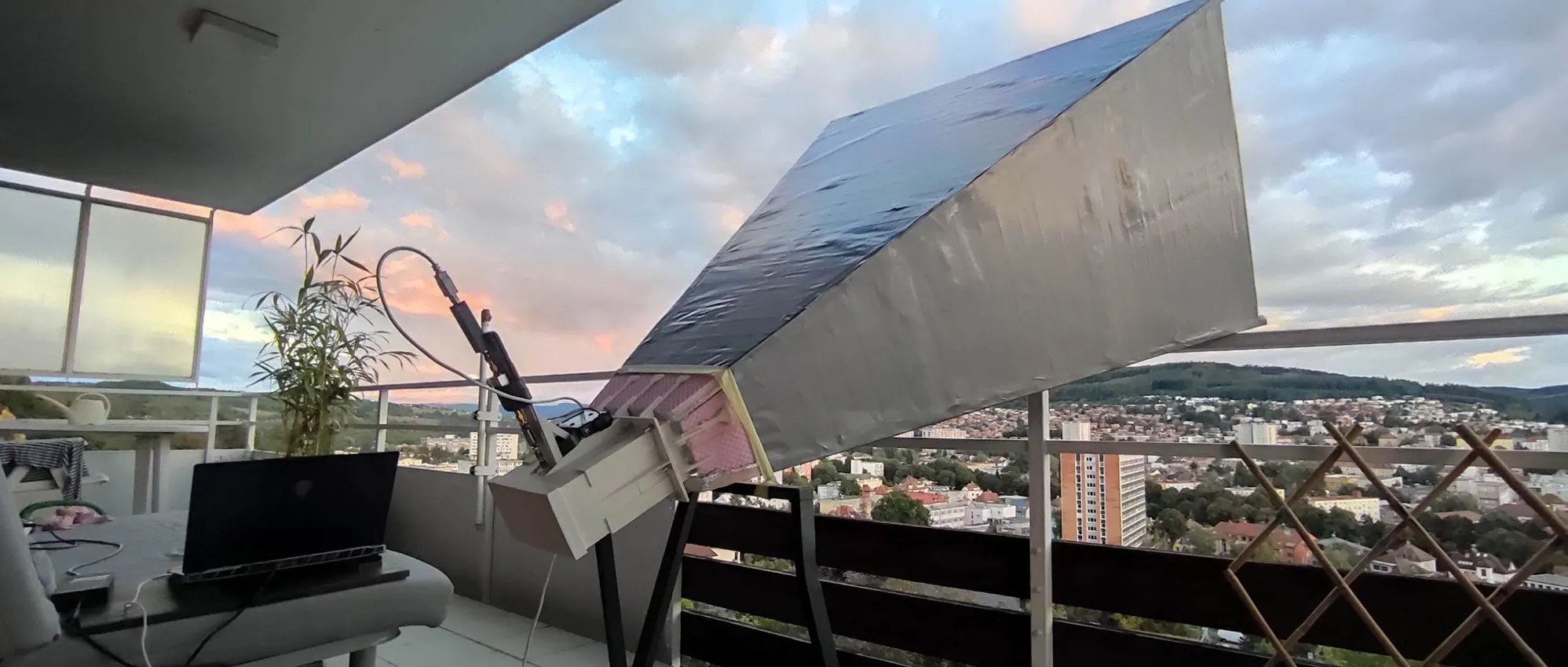
A quick software tool using matplotlib with Python to procedurally design optimal horn antennas for specific frequency, gain, and impedance parameters.
Original calculations were done at: https://3g-aerial.biz/en/online-calculations/antenna-calculations/horn-antenna-online-calculator
I have added visualization of parts and a GUI to it.
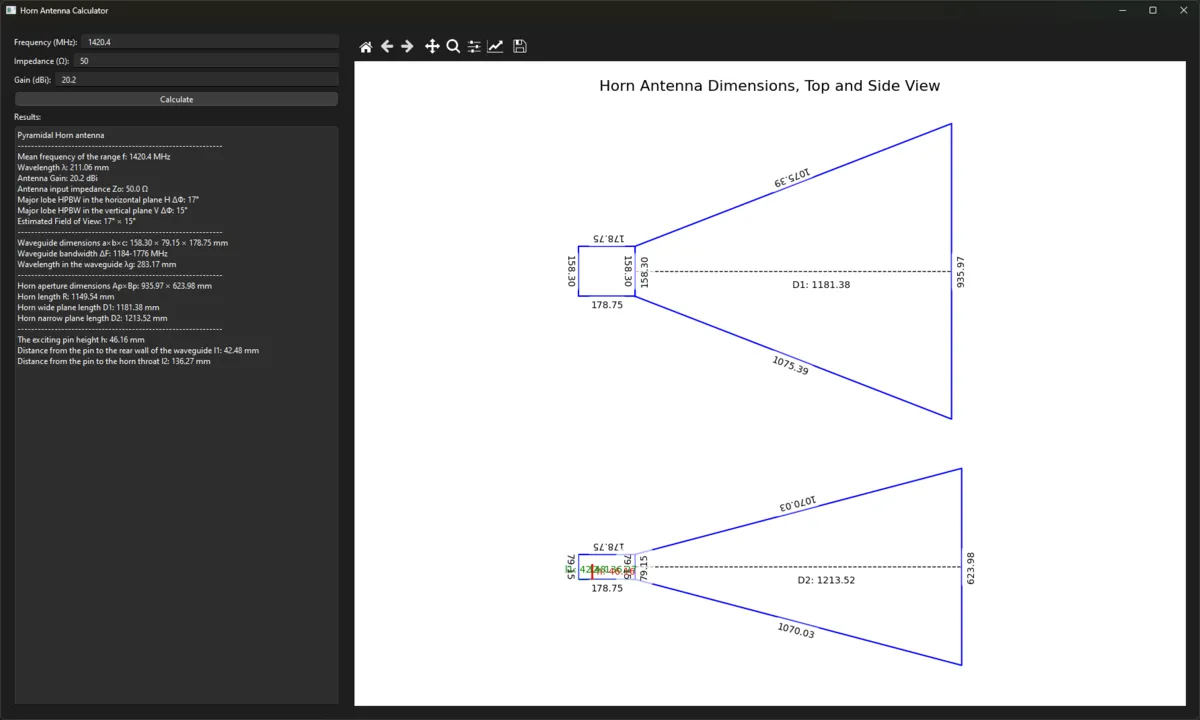
Photo: Parameters and the resulting TOP and SIDE views with the measurements of our ideal final antenna.
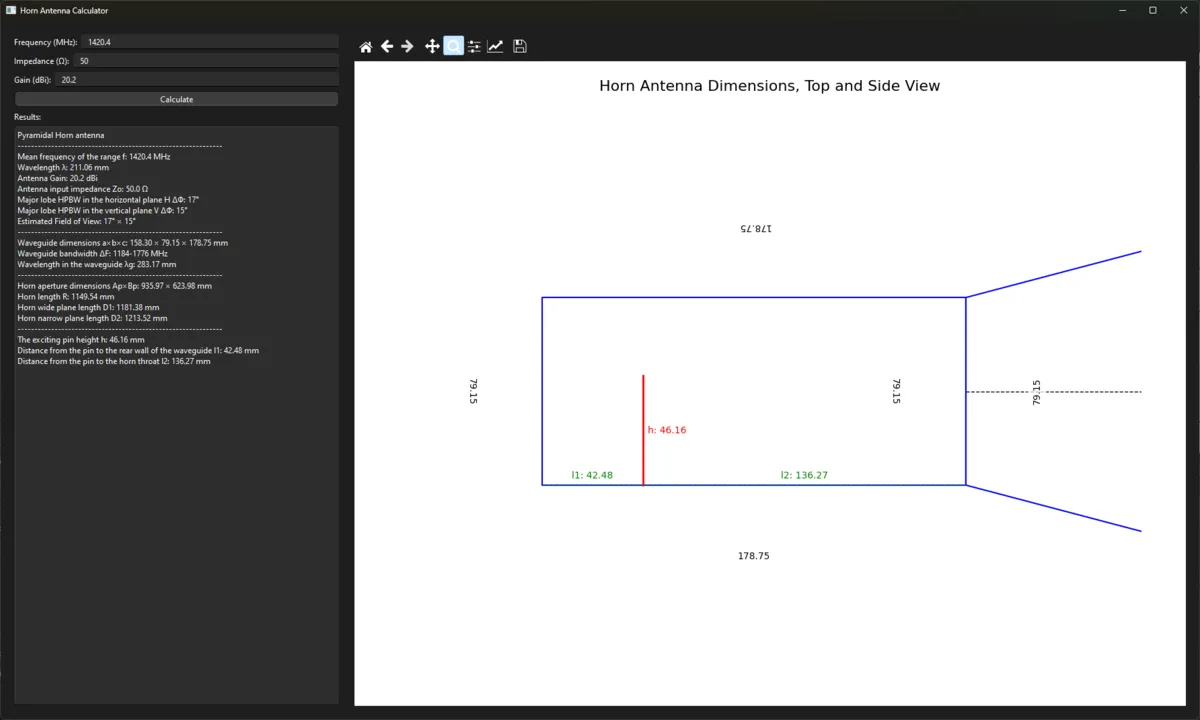
Photo: Detail of the SIDE view of the waveguide with probe height and location.
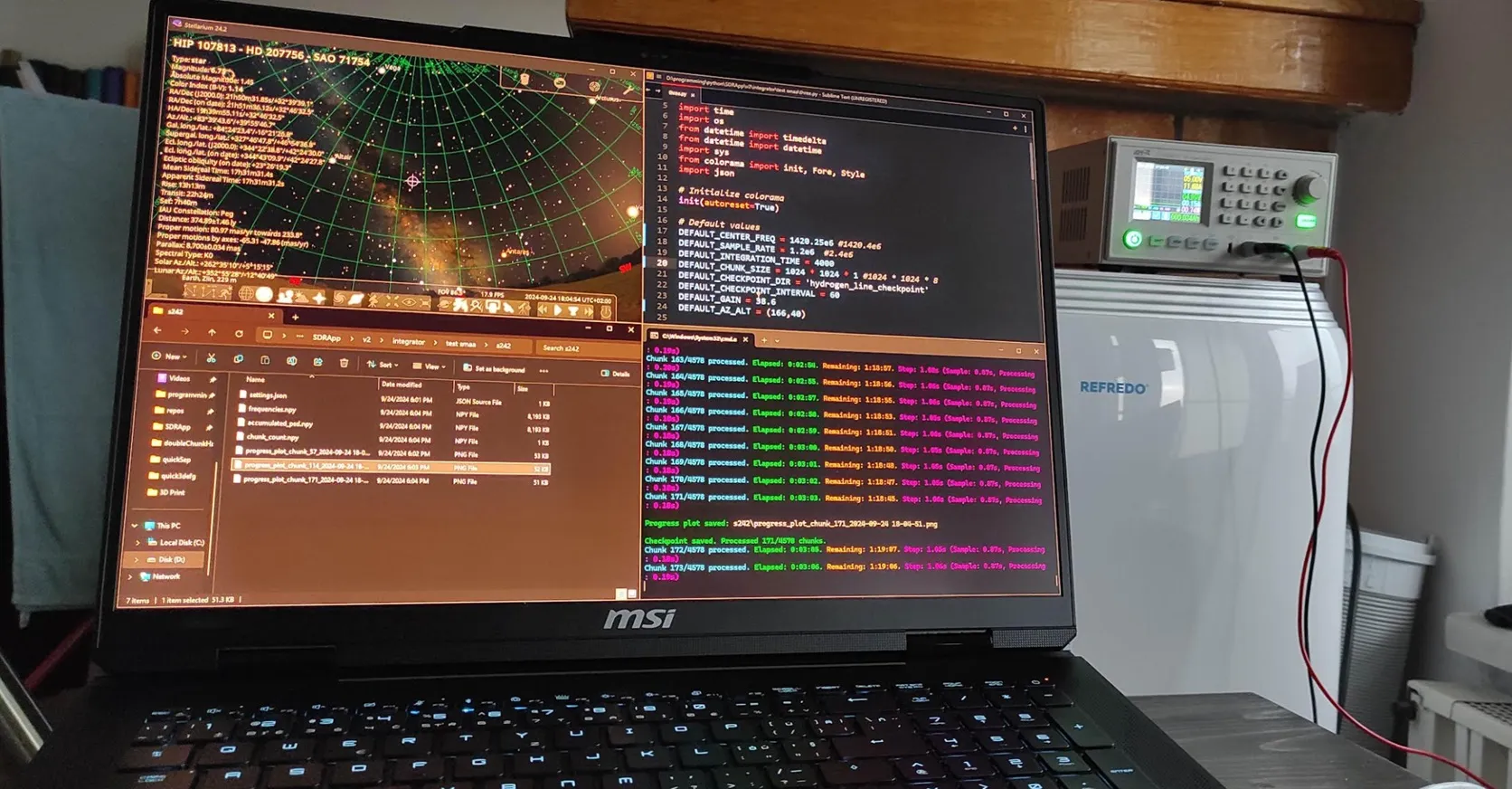
Photo: Custom DIY software for the antenna with realtime tracking using Stelarium.
Code: Github
Output example for the Hydrogen Line at a 1420.4 MHz central frequency:
Pyramidal Horn antenna
Pyramidal Horn antenna
- Mean frequency of the range f: 1420.4 MHz
- Wavelength λ: 211.06 mm
- Antenna Gain: 20.31635 dBi
- Antenna input impedance Zo: 50.0 Ω
- Major lobe HPBW in the horizontal plane H ΔΦ: 17°
- Major lobe HPBW in the vertical plane V ΔΦ: 15°
- Estimated Field of View: 17° × 15°
- Waveguide dimensions a×b×c: 158.30 × 79.15 × 178.75 mm
- Waveguide bandwidth ΔF: 1184-1776 MHz
- Wavelength in the waveguide λg: 283.17 mm
- Horn aperture dimensions Ар×Вр: 949.26 × 632.84 mm
- Horn length R: 1185.79 mm
- Horn wide plane length D1: 1217.68 mm
- Horn narrow plane length D2: 1250.00 mm
- The exciting pin height h: 46.16 mm
- Distance from the pin to the rear wall of the waveguide l1: 42.48 mm
- Distance from the pin to the horn throat l2: 136.27 mm
I of course plan to simulate it in Ansys HFSS, but that will come later. For now, I will just make one and test it in the field.